

Judicial Determination and Boundary Analysis of Intentional Homicide and Intentional Injury
From legal logic to practical approach
Author: Lawyer Dong Minggang
Estimated reading time: 30 minutes
In the Special Provisions of my country's Criminal Law, intentional homicide and intentional injury are both serious crimes that infringe upon citizens' personal rights. However, due to differences in subjective malice and social harm, they face drastically different sentencing tiers. The statutory penalty for intentional homicide is death, life imprisonment, or imprisonment for more than ten years, with even minor offenses subject to imprisonment for three to ten years. Intentional injury, on the other hand, is divided into three levels of sentencing based on the severity of the injury: causing minor injury is punishable by imprisonment for up to three years, detention, or public surveillance; causing serious injury is punishable by imprisonment for three to ten years; and causing death or serious injury resulting in severe disability through particularly cruel means is punishable by imprisonment for more than ten years, life imprisonment, or death.
The root cause of this sentencing difference lies in the different degrees of harm inflicted on legal interests by the two crimes: intentional homicide directly targets the citizen's right to life, while intentional injury only targets the right to physical health. However, in judicial practice, the distinction between the two crimes often falls into the dilemma of "different interpretations for the same act"—when a perpetrator uses knives, sticks, or other tools to attack others, resulting in injury or death, how to determine whether their subjective intent was "pursuing/indulging in death" or "merely pursuing/indulging in harm" often becomes the core of the dispute between the prosecution and the defense, and directly affects the outcome of the case.
Taking the case of Wang Moumou, suspected of intentional homicide, as an example, the public security organs determined that he was guilty of intentional homicide on the grounds that he "slashed the victim's neck with a utility knife." However, the defense counsel, through reviewing the police report at the time of the incident (instant confession of "intentional injury"), the rescue actions taken after the crime (requesting a third party to take the victim to the hospital), and the injury assessment (non-fatal injury), argued that his subjective intent was only to cause harm, and that the crime should be classified as intentional injury. This case reflects the core proposition of distinguishing between the two crimes:The determination of subjective culpability cannot be based solely on the superficial characteristics of objective behavior, but requires a comprehensive judgment based on all the evidence in the case.
This article will start from the legal elements of a crime, combine criminal law theory, judicial interpretations and typical cases to systematically sort out the criteria for distinguishing between the two crimes, focus on analyzing the judicial determination path of subjective culpability, and explore the points of contention and solutions in practice, so as to provide a reference for judicial practice and legal popularization.
one
Legal distinction between intentional homicide and intentional injury
Comparative analysis of constituent elements
To accurately distinguish between the two crimes, it is first necessary to clarify the differences in their legal elements. According to Articles 232 (Intentional Homicide) and 234 (Intentional Injury) of the Criminal Law of the People's Republic of China, the two crimes partially overlap in terms of object, objective aspect, and subject, but there are essential differences in the subjective aspect, which is the core of distinguishing between the two crimes.
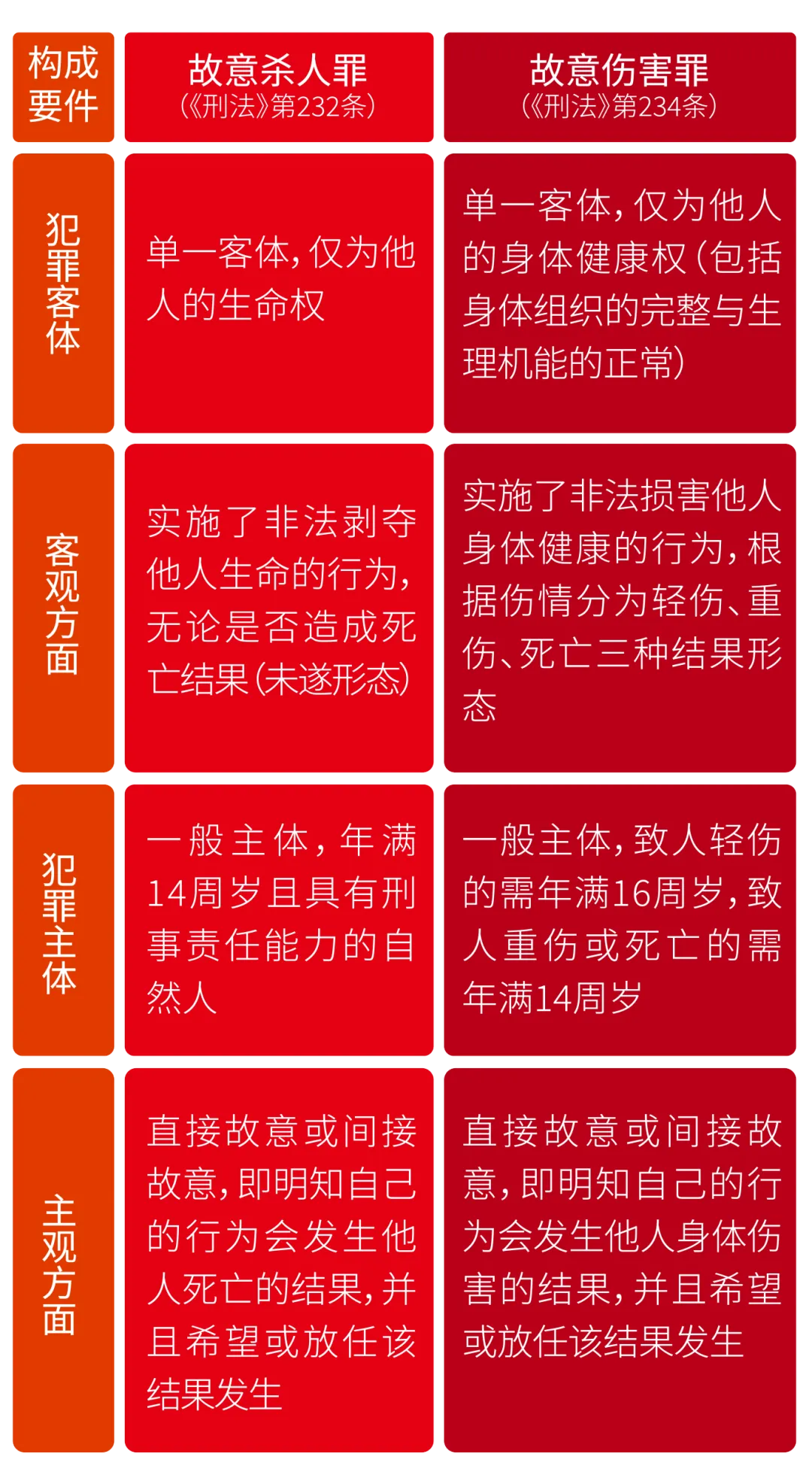
As can be seen from the table, the core difference between the two crimes lies in...Object and subjective aspect of crimeThe former determines the essential object of the crime, while the latter determines the degree of subjective malice of the perpetrator. It is particularly important to note that the crime of intentional injury can exist as a "result-aggravated offense" (resulting in death). In this case, the objective result is the same as that of intentional homicide (completed), but there is still a fundamental difference in the subjective aspect—the perpetrator of intentional injury resulting in death has a negative attitude towards the "death result" (considered negligence), while the perpetrator of intentional homicide has a desire for or indifference towards the "death result."
✦1.2.1✦
Subjective culpability:
Attitude towards the "outcome of death" is the key distinction.
According to Article 14 of the Criminal Law regarding intentional crimes, the core of "intent" is "the knowledge and willful attitude towards the harmful result." For two crimes, the objective acts may be highly similar (e.g., both involving attacking others with a knife), but the subjective attitude towards the "death result" directly determines the charge.
Intention in the crime of intentional homicide:
The perpetrator is aware that his/her actions "may or inevitably" cause the death of another person, and holds an attitude of "hope" (actively pursuing, such as directly stabbing the heart) or "indifference" (not caring whether the person will die, such as randomly swinging a knife in a crowd) towards the death result;
Intention in the crime of intentional injury:
The perpetrator is aware that his/her actions "may or inevitably" cause bodily harm to others (such as cuts, fractures, etc.), and holds a hopeful or indifferent attitude towards the result of such harm, while holding an "averse" attitude towards the "death result" (if the death result occurs, it should be considered as negligent homicide, constituting an aggravated offense of intentional injury).
In his book *Criminal Law* (6th edition), criminal law scholar Zhang Mingkai points out that "the distinction between intentional homicide and intentional injury lies not in the manner of the act, but in whether the perpetrator is aware that their actions will result in the death of another, and whether they desire or allow that result to occur. Even if the perpetrator uses a lethal weapon, as long as their subjective intent is solely to cause harm, it should be considered intentional injury." This view is widely accepted in judicial practice—the Supreme People's Court, in its *Guiding Opinions on the Correct Application of Law in the Trial of Intentional Homicide and Intentional Injury Cases*, clarifies that "to determine whether someone is guilty of intentional homicide, it must be proven that the perpetrator had the subjective intent to kill; if there is insufficient evidence to prove the intent to kill, it cannot be considered intentional homicide, but if the elements of intentional injury are met, it should be convicted of intentional injury."
✦1.2.2✦
Legal interest target:
The hierarchical differences between the right to life and the right to physical health
The right to life is the most basic personal right of citizens and a prerequisite for the right to health—without life, there is no health.Therefore, the degree of harm to legal interests caused by intentional homicide is far greater than that caused by intentional injury, which is the fundamental reason why its statutory penalty is heavier.
It is important to note that infringement of the "right to physical health" does not include infringement of the right to life: when a person's actions directly result in the death of another, if their intent is to cause harm, it falls under the category of "intentional injury resulting in death" (an aggravated offense), rather than intentional homicide. For example, if a person strikes another person's leg with a wooden stick during an argument, intending to cause a fracture (intent to cause harm), but the victim falls and dies from a head injury, this should be considered intentional injury (resulting in death), not intentional homicide.
two
Judicial Determination Path of Subjective Guilt
From "reliance on testimonies" to "comprehensive review of all evidence"
In judicial practice, perpetrators often do not voluntarily admit "I wanted to kill" or "I only wanted to injure," and may even give contradictory statements due to misunderstandings of the law (such as confusing the meanings of "injury" and "murder"). For example, in the case of Wang, he initially stated "intentional injury," but later changed his statement to "murder." Therefore,The determination of subjective culpability cannot rely on a single confession, but must combine immediate evidence, objective behavior, injury assessment, and behavior before and after the incident to construct a complete chain of evidence.
Verbal evidence includes statements from perpetrators, victims, and witnesses. Among these, statements made by the perpetrator at the time of the incident (such as statements to the police or on-site statements to witnesses) have the highest probative value because they are not subject to external interference (such as lawyer intervention, concerns about legal consequences, or memory bias). Subsequent statements (such as statements made after detention or arrest) may be biased due to cognitive errors, emotional changes, or external suggestions, and their probative value should give way to immediate evidence.
✦2.1.1✦
Advantages of immediate evidence in terms of probative value:
Take Wang Moumou's case as an example
In Wang's case, the case file shows that after the incident on [Date], the victim, Li, left the scene only seconds later. Wang immediately dialed 110 to report the crime, clearly stating, "I am reporting the crime, I surrender myself, I committed intentional assault." This confession has the following irreplaceable advantages.
Timeliness:Immediately after committing the act of harm, the individual has the clearest understanding of the nature of the act and there is no possibility of memory lapse.
objectivity:It was not influenced by external factors (no legal guidance, no suggestion from others), and it is a true reflection of my inner self;
consistency:This corroborates subsequent objective actions (no escape, request for medical treatment), ruling out the possibility of "intentional fabrication."
Conversely, Wang's statement regarding the alleged murder during his arrest on [Date] was found to stem from his "low level of education (junior high school) and lack of legal knowledge." He simplistically equated "cutting the neck with a knife" with "intending to kill the other person," neglecting the legal requirement that "intentional homicide requires the goal of death." This contradiction in his statement, caused by a misunderstanding of the law, cannot be used as evidence to establish intent to kill.
✦2.1.2✦
The supplementary role of witness testimony:
Reconstructing the subjective state at the time of the crime
Witness testimony, especially that of witnesses at the scene, can objectively reflect the perpetrator's words and actions at the time of the incident, aiding in the determination of subjective culpability. For example, if a witness testifies that "the perpetrator shouted 'I don't want to kill you, I just want to teach you a lesson' after the attack," it can directly corroborate the intent to harm; if a witness testifies that "the perpetrator said 'I'm going to kill you' during the attack," it may corroborate the intent to kill.
It is important to note that witness testimonies must be examined for their veracity, excluding factors such as a conflict of interest with the parties involved or memory bias. For example, the testimony of a witness who is related to the victim may be biased and must be considered in conjunction with other evidence for a comprehensive judgment.
"Subjective intent governs objective reality, and objective reality reflects subjective intent" is a fundamental principle of criminal law. Whether a perpetrator has the intent to kill is often revealed through the details of their objective actions, which can be examined from the following three dimensions:
✦2.2.1✦
The supplementary role of witness testimony:
Reconstructing the subjective state at the time of the crime
The lethality of tools:
If the perpetrator chooses a highly lethal tool such as a firearm, a controlled knife, or a blunt instrument (such as a hammer), and uses the lethal function of the tool (such as stabbing rather than slashing), it may corroborate the intent to kill; if the perpetrator chooses an everyday tool (such as a fruit knife or a wooden stick) and uses a non-lethal function (such as hitting the arm with a wooden stick), it is more likely to corroborate the intent to injure.
Fatality of the location:
If the perpetrator attacks vital areas such as the heart, chest, neck (carotid artery), or head with considerable force, it may provide evidence of intent to kill; if the attack targets non-vital areas such as the limbs or buttocks, it is more likely to provide evidence of intent to injure.
It is important to note that the "lethality of the tool and the location" cannot be used as the sole basis for determination; it must be considered in conjunction with other actions. For example, although Wang used a utility knife to slash the victim's neck, he did not damage the carotid artery (a non-lethal area) and did not continue the attack. Therefore, the intent to kill cannot be determined solely based on "slashing the neck."
✦2.2.2✦
The duration of the harmful process:
Should we pursue a "fatal outcome"?
The perpetrator of intentional homicide usually "pursues the achievement of a fatal result," which is manifested in the continuous attack until the victim loses the ability to resist; while the perpetrator of intentional injury often stops the attack after causing injury, and may even take rescue measures.
Determination of a persistent attack:
For example, if a perpetrator stabs a victim in the chest with a knife and, seeing that the victim has not fallen to the ground, stabs the victim several more times until the victim stops breathing, this can be considered as intent to kill. If a perpetrator cuts the victim's arm with a knife and, seeing that the victim is bleeding, stops attacking and turns away, it is more likely to be considered as intent to injure.
Preventing escape:
If the perpetrator actively pursues and continues to attack the victim when the victim attempts to escape, it may corroborate the intent to kill; if the perpetrator allows the victim to leave without pursuing, it is more likely to corroborate the intent to harm.
In the case of Wang Moumou, the video of the incident shows that after Wang Moumou slashed Li Moumou's neck with a utility knife, he did not continue to pursue Li Moumou when Li Moumou struggled and resisted. Instead, he let Li Moumou leave the scene. This behavior is completely contrary to the murder intent of "pursuing a fatal result" and is consistent with the subjective mentality of "only pursuing the result of harm".
✦2.2.3✦
Rescue actions after harm:
Attitude towards "the outcome of death"
The rescue behavior after the harm is a key indicator for judging the perpetrator's attitude towards the "death result" - if the perpetrator has a negative attitude towards the death result (intent to harm), they will usually take the initiative to take rescue measures (such as calling 120 or asking others to take them to the hospital); if the perpetrator has an indifferent or hopeful attitude towards the death result (intent to kill), they will choose to run away, destroy evidence, or even prevent others from providing rescue.
Determination of proactive rescue:
For example, if a perpetrator stabs a victim and then immediately calls 120 (emergency services) and waits at the scene for medical personnel, truthfully reporting the location of the wound, this can directly prove intent to cause harm. If, after stabbing the victim, the perpetrator drags them to a secluded place and flees the scene without taking any rescue measures, this may prove intent to kill.
Cooperating with the actions of judicial authorities:
If the perpetrator voluntarily calls the police, stays at the scene to await arrest, and truthfully confesses the course of the act, it usually indicates that he has no intention of evading legal responsibility, indirectly proving the intent to harm (if the intent is to kill, he is more likely to choose to flee).
In the case of Wang Moumou, after the victim left, Wang Moumou not only took the initiative to call the police and surrender himself, but also asked a third party at the scene to "take care of Li Moumou and take her to the hospital." This proactive rescue behavior directly reflects his rejection of the "death outcome" and is important evidence for determining intent to cause harm.
An injury assessment report is legal evidence for determining the actual extent of harm caused by the perpetrator. Although it cannot directly determine subjective culpability, it can infer whether the perpetrator pursued a fatal outcome by examining the "fatality of the injury," and thus has important reference value.
✦2.3.1✦
The correlation between the fatality of the injury and subjective culpability
If the injury is a "fatal wound"
(Such as a ruptured heart, a severed carotid artery, or a comminuted fracture of the skull), and the perpetrator used a deadly weapon and launched a sustained attack, which may corroborate the intent to kill.
If the injury is "non-life-threatening"
(Such as skin lacerations, fractures, or minor organ damage), and the absence of sustained aggressive behavior, are more likely to corroborate intent to harm.
In the case of Wang Moumou, the discharge diagnosis from XXX Medical College of Xi'an Medical University showed that Li Moumou's injuries were "lacerations to the skin on the neck, lacerations and avulsions to the skin on the face, and tracheal injury," but none of them damaged the carotid artery or trachea, and none caused suffocation. After treatment, she was discharged from the hospital (without risk of death). This non-fatal injury is completely consistent with Wang Moumou's subjective intent that "he only sought to cause harm, not to kill"—if Wang Moumou truly had the intent to kill, given the disparity in strength between him and Li Moumou (a man against a woman, who could have been thrown to the ground and controlled), he was fully capable of causing fatal injuries, rather than just non-fatal skin and tracheal injuries.
✦2.3.2✦
Limitations of injury assessment:
It cannot be used as a sole basis
It is important to note that injury assessment only reflects the "actual damage," while subjective culpability reflects the "perpetrator's intent," and there may be discrepancies between the two. For example, if a perpetrator intends to kill a victim and stabs them in the chest with a knife, but the victim is wearing heavy clothing and the wound is not fatal (only minor injury), it should still be considered attempted murder. Conversely, if a perpetrator intends to harm a victim and strikes their legs with a wooden stick, but the victim falls and dies from hitting their head on the ground, it should be considered intentional injury resulting in death.
therefore,Injury assessment must be combined with other evidence (such as the choice of tool, the location of attack, and the duration of the attack) for a comprehensive judgment. It cannot be determined as intentional injury based solely on "minor injury" or as intentional homicide based solely on "death".
The perpetrator's motive for committing the harmful act (such as emotional disputes, economic conflicts, or neighborhood disputes) and the circumstances of the incident (such as whether they were stimulated or whether there were defensive factors) can also affect the determination of subjective culpability. Generally speaking, "sudden and stimulating" motives are more likely to lead to intentional injury (impulsive crime), while "premeditated and retaliatory" motives are more likely to lead to intentional homicide (planned crime).
✦2.4.1✦
The nature and intensity of the conflict beforehand
Premeditated conflict:
If the perpetrator has long-standing grievances (such as being bullied by the victim multiple times or having unresolved economic disputes), and prepares a deadly tool (such as purchasing a dagger) beforehand and chooses the time of the crime (such as when the victim is returning home alone), this may corroborate the intent to kill.
Sudden conflict:
If a person launches an attack on the spot due to a temporary argument or emotional provocation (such as discovering they have been deceived) without having prepared any tools beforehand, it is more likely to prove intent to harm.
In Wang's case, the root of the conflict was that "Li concealed his marital status and cohabited with Wang for a long time, and Wang discovered he had been deceived after their breakup," which constituted a sudden emotional dispute. The utility knife that Wang carried was "purchased several years ago and carried with him before the incident because he intended to commit suicide by cutting his wrists," and was not a tool specifically prepared to harm Li. This "unpremeditated, impromptu" motive further corroborates that his subjective intent was to cause harm.
✦2.4.2✦
Stimulation level of the situation
If the perpetrator is subjected to extreme provocation from the victim (such as verbal insults or violent provocation) before committing the act, it may lead to emotional instability and aggressive behavior, which is more likely to be considered as intentional injury (impulsive crime); if the perpetrator attacks the victim without provocation, it is more likely to be considered as intentional homicide.
In Wang's case, the case file shows that when Wang confronted Li, Li not only refused to communicate but also cut off Wang's SIM card, locked him out, and verbally provoked him by saying, "I cheated with my own skills, so what?" This extreme provocation caused Wang to have a mental breakdown and commit an attack on the spot—this kind of "impulsive crime after being provoked" is more likely to be a "venting of emotions and causing harm" rather than a "pursuit of death."
three
Common points of contention in judicial practice
Analysis of typical cases
Although the aforementioned approach to identification has reached a consensus, some complex situations still exist in judicial practice that make it difficult to distinguish between the two crimes. This section will further clarify the boundaries between the two crimes by combining guiding cases issued by the Supreme People's Court and typical points of contention in judicial practice.
In practice, some law enforcement officers believe that "any attack on vital areas such as the heart or neck should be considered intentional homicide," but this view ignores the "relationship between subjective intent and objective behavior."Attacking vital areas may be "aiming for harm" (such as scratching the skin of the neck to show a threat) or "aiming for death" (such as stabbing the carotid artery), and a comprehensive judgment needs to be made in conjunction with other evidence.
When a victim dies, distinguishing between "intentional injury resulting in death" (an aggravated offense) and "completed intentional homicide" is a difficult point in judicial practice. Both result in death, but their subjective culpability differs: the former is negligent in the face of death, while the latter is hopeful or indifferent to the outcome of death.
To distinguish between "intentional injury resulting in death" and "completed intentional homicide," the following three points need to be examined in detail:
Persistence of the attack:
Whether the attack continues until the victim loses the ability to resist (intentional homicide usually involves continuous attack, while intentional assault usually involves ceasing the attack).
Subsequent actions:
Whether to take rescue measures (rescue may be possible for intentional injury, while for intentional homicide, escape or destruction of evidence is usually the answer);
Subjective motivation:
Whether it was premeditated or retaliatory (murder with intent is more likely to be premeditated).
Indirect intent (allowing the result to occur) is another difficult point in distinguishing between the two crimes—the indirect intent in intentional homicide is "allowing the death to occur," and the indirect intent in intentional injury is "allowing the injury to occur." However, "allowing" itself is a vague subjective state that needs to be inferred from objective behavior.
The key to determining "indirect intent" is whether "the actor was aware of the possibility of the result occurring, and whether he/she had an 'indifferent' attitude towards the result":
If the person involved is aware that "their actions may result in death."If someone is indifferent to the outcome (such as randomly brandishing a knife in a crowd, regardless of whether they kill someone), then they are guilty of intentional homicide (indirect intent).
If the actor only recognizes that "his actions may result in harm",If one is unaware of or rejects the "result of death," it constitutes the crime of intentional injury (indirect intent or negligence).
Four
Relationship between sentencing factors and the two crimes
Differences in the application of broad-based scenarios
After clarifying the boundaries of the two crimes, the application of sentencing factors will also differ depending on the crime. This section will analyze the application rules of leniency factors (surrender, attempted crime, victim's fault, etc.) in the Wang Moumou case, further reflecting the principle of "proportionality between crime and punishment".
According to Articles 67 (surrender) and 68 (meritorious service) of the Criminal Law, surrender and meritorious service are statutory mitigating circumstances shared by both crimes, but the degree of leniency must be adjusted in conjunction with the subjective culpability of the crime when applying them.
Intentional homicide:
Because of the high degree of subjective malice, surrendering oneself or making meritorious contributions usually only "can result in a lighter or reduced punishment", and in cases of particularly heinous circumstances (such as cruel methods or serious consequences), leniency may not even be granted.
Intentional injury:
Because the subjective malice is relatively small, the leniency is greater for those who surrender themselves or perform meritorious service. If it is a case of minor injury, they may even be "exempt from punishment".
According to Articles 23 (Attempt) and 24 (Suspension) of the Criminal Law,The leniency granted for attempted crimes is far greater than for unintentional crimes: attempted crimes "may be punished more leniently or with a reduced sentence," while those who abandon their crimes "should be exempted from punishment if no harm is caused; and should have their punishment reduced if harm is caused."
In Wang's case, the defense argued that his actions constituted attempted intentional injury, for the following reasons:
After committing the act of harm, Wang voluntarily gave up on continuing to harm the victim (allowing the victim to leave without pursuing him).
Actively take rescue measures (request a third party to take the patient to the hospital) to effectively prevent the harm from escalating;
The damage caused constitutes minor injury, which falls under the category of "those who cause damage shall be given a reduced penalty".
It is important to note thatThe determination of attempted crime requires meeting two criteria: "voluntary" (abandoning the crime for reasons within one's own will) and "effective" (preventing the escalation of the consequences).If a person abandons a crime due to reasons beyond their control (such as the victim escaping or being stopped by others), it constitutes an attempt, not an interruption.
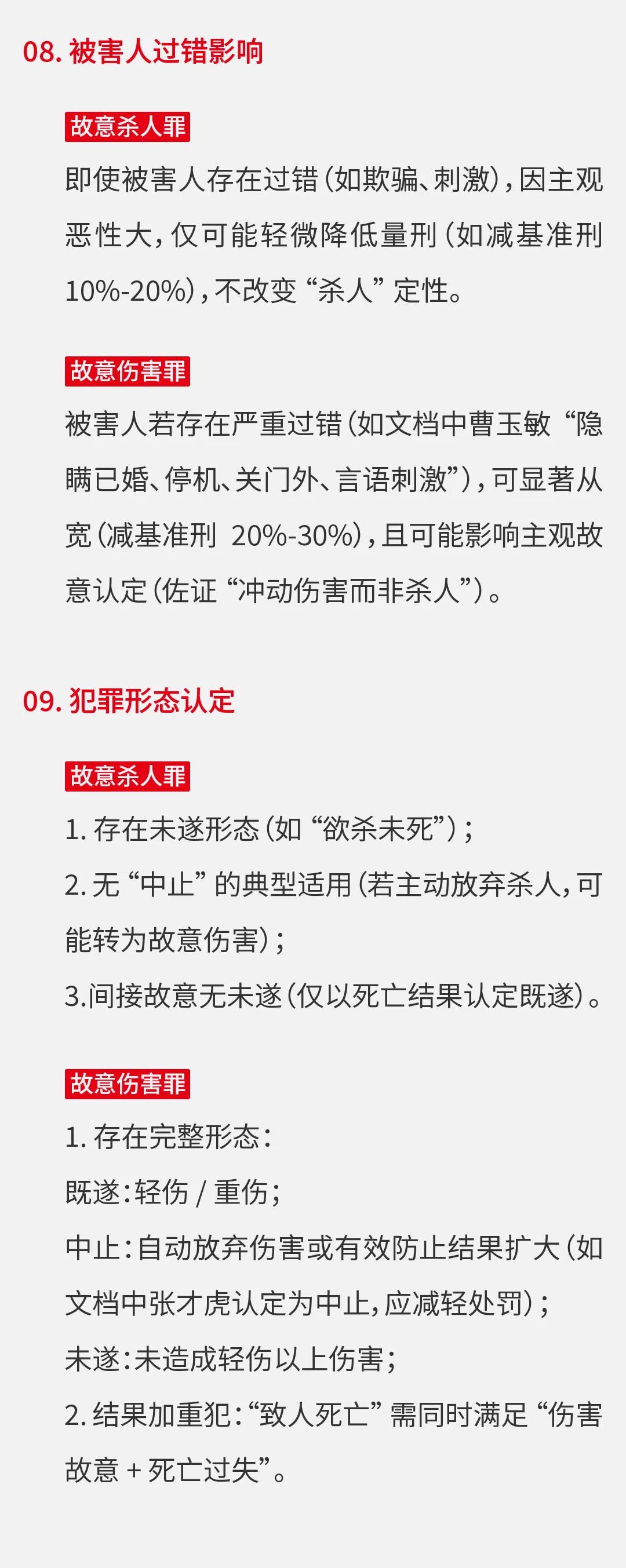
According to Article 11 of the "Guiding Opinions on Sentencing by People's Courts (Trial Implementation)," "If the victim has serious fault or bears primary responsibility for escalating the conflict, the base sentence may be reduced by 20%-30%." Victim fault is a mitigating circumstance in both crimes, but it is more commonly applied in the crime of intentional injury (because intentional injury often stems from civil disputes).
In Wang's case, Li's faults included:
Concealing her marital status and cohabiting with Wang constitutes deception.
They deactivated Wang's SIM card, locked him out of the room, and cut off all communication channels.
Verbal provocations such as "I cheated with my own skills" escalate the conflict.
These mistakes constitute "serious mistakes" and they bear primary responsibility for escalating the conflict.
According to Article 18 of the "Shaanxi Sentencing Rules", "If the victim actively compensates for economic losses but fails to obtain forgiveness, the base sentence may be reduced by up to 10%; if forgiveness is obtained, the base sentence may be reduced by up to 20%".Compensation and forgiveness can both lead to leniency in both crimes, but they have a greater impact on sentencing in the crime of intentional injury (especially in cases of minor injury, where obtaining forgiveness may result in a suspended sentence).。
In the case of Wang Moumou, Wang Moumou and his family made multiple attempts to compensate him (visiting the victim, paying medical expenses in advance, and entrusting others to communicate), but failed to obtain Li Moumou's forgiveness because Li Moumou refused to communicate. According to the "Shaanxi Sentencing Rules", "if all means of compensation have been exhausted but forgiveness has not been obtained, the base sentence may be reduced by up to 10%".
five
Difficulties in Judicial Practice
Improvement suggestions
Although my country has established relatively complete rules for distinguishing between the two crimes, problems such as "difficulty in evidence collection" and "excessive judicial discretion" still exist in practice. This section will analyze these difficulties and propose targeted suggestions for improvement.
Subjective culpability refers to the perpetrator's internal psychological state, which cannot be directly observed and can only be inferred through circumstantial evidence. In practice, the collection of circumstantial evidence often faces the following difficulties:
Lacking immediate evidence:
In some cases, there were no on-site witnesses or police reports, and the perpetrators fled after the incident, making it impossible to obtain immediate confessions.
The objective behavior is ambiguous:
In some cases, due to issues with the camera angle and insufficient lighting, it is impossible to clearly reconstruct the process of the attack (such as whether the attack was continuous or whether any assistance was provided).
Contradictory verbal evidence:
The statements/testimonies of the perpetrator, the victim, and the witnesses are contradictory and lack corroborating evidence, making it difficult to determine their authenticity.
For example, in cases of intentional injury/homicide that occur in remote areas, if there is no surveillance, no witnesses, and the perpetrator and the victim have conflicting accounts (the perpetrator claims "I only wanted to hurt them," while the victim claims "the other party wanted to kill me"), the determination of subjective culpability will be difficult.
✦5.2.1✦
Develop clearer standards for evidence review
The Supreme People's Court may jointly issue relevant guidelines with the Supreme People's Procuratorate, clarifying the following:
Priority review list for immediate evidence:
This includes police reports, on-site audio and video recordings, and immediate witness testimonies, which clearly demonstrate that their probative value is higher than that of subsequent confessions.
Elements of objective behavior review:
Clearly define the weight of factors such as "tool selection, target area, duration, and rescue actions." For example, "using a deadly tool + attacking a fatal area + continuous attack + no rescue" can strongly corroborate intent to kill.
Reference standards for injury assessment:
Clearly define the specific medical standards for "fatal injury" and "non-fatal injury" to avoid discrepancies in assessments due to vague wording in expert opinions.
✦5.2.2✦
Strengthen case guidance and unify judgment standards
The Supreme People's Court can periodically publish guiding cases on "distinguishing between intentional homicide and intentional injury," covering different situations (such as attacks on vital parts, resulting in death, indirect intent, etc.) and clarifying the rules of adjudication. For example, regarding the situation of "attacking the neck," cases can clarify that "whether the carotid artery was injured, whether the attack was continuous, and whether rescue was provided" are the key factors in the determination, avoiding a "one-size-fits-all" approach to determination.
✦5.2.3✦
Strengthening the right of both the prosecution and the defense to examine evidence
During the trial, the right of both the prosecution and the defense to cross-examine evidence related to subjective culpability should be fully guaranteed. The prosecution should be required to provide a complete chain of evidence to establish "intent to kill," and the defense has the right to question the authenticity and relevance of the evidence. For example, if the prosecution only establishes intent to kill based on "attack on vital parts," the defense can request other evidence such as "continuous attack and lack of assistance," otherwise the defense should bear the burden of evidence.
The distinction between intentional homicide and intentional injury is a typical manifestation of the principle of "unity of subjective and objective elements" in criminal law. One cannot determine the intent to kill solely based on objective behavior (such as attacking vital parts), nor can one determine the intent to injure solely based on the perpetrator's confession (such as denying killing). Instead, one must combine all the evidence in the case and construct a complete chain of evidence from dimensions such as immediate evidence, objective behavior, injury assessment, and behavior before and after the incident to accurately determine the perpetrator's subjective culpability.
From the Wang Moumou case to the guiding cases of the Supreme People's Court, judicial practice has consistently confirmed a core rule: the essence of conviction is a dual evaluation of "the perpetrator and the act." Subjective culpability determines the essential attributes of the act, while objective evidence determines the basis for determining subjective culpability. Only by accurately distinguishing between the two crimes can the principle of "proportionality between crime and punishment" be achieved, ensuring that those who commit intentional homicide do not escape severe punishment, nor that those who intentionally cause harm bear excessive criminal responsibility.
For judicial personnel, it is essential to maintain caution when handling cases, avoiding an "outcome-oriented" approach (such as concluding intentional homicide simply because someone dies), and strictly adhering to the rules of evidence to examine subjective culpability. For ordinary citizens, it is crucial to understand the criteria for distinguishing between the two crimes, enhance legal awareness, and avoid behavioral deviations due to misunderstandings of the law (such as confusing the meanings of "injury" and "homicide"). Only in this way can we protect citizens' personal rights while upholding the fairness and authority of criminal law.
Appendix
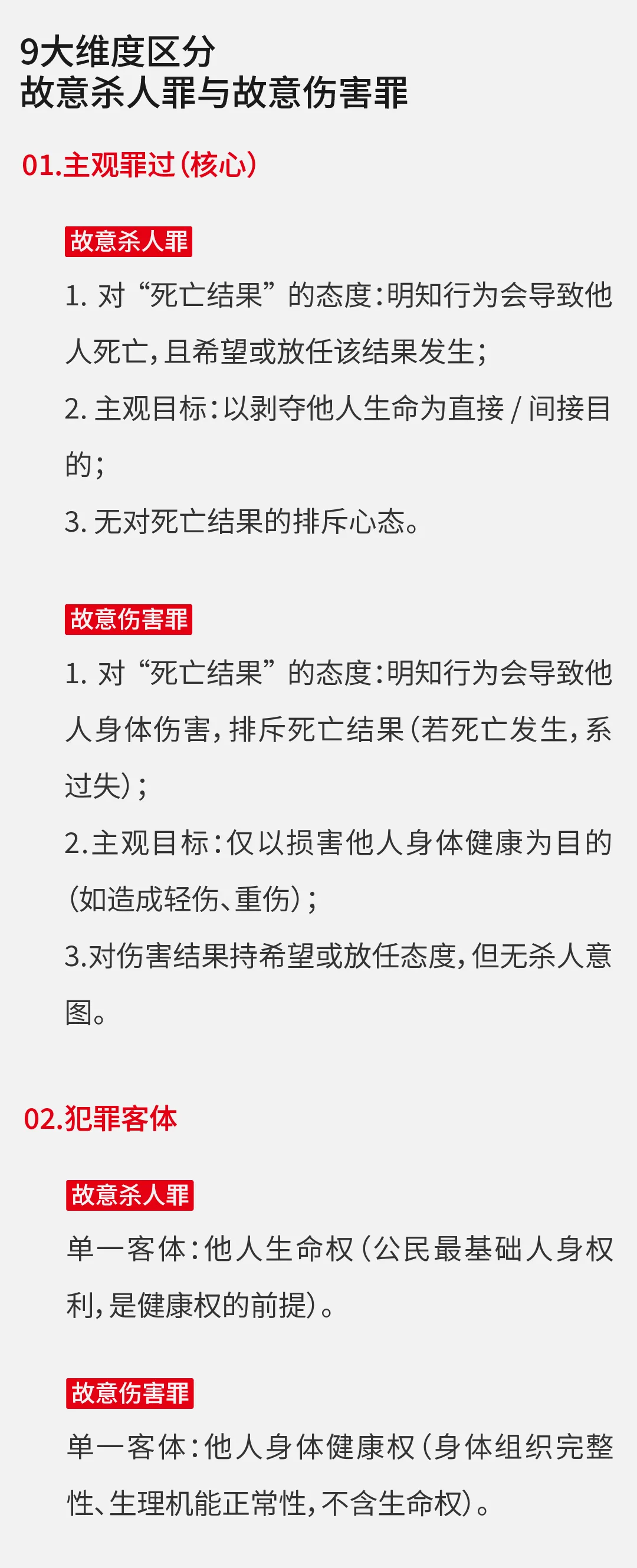
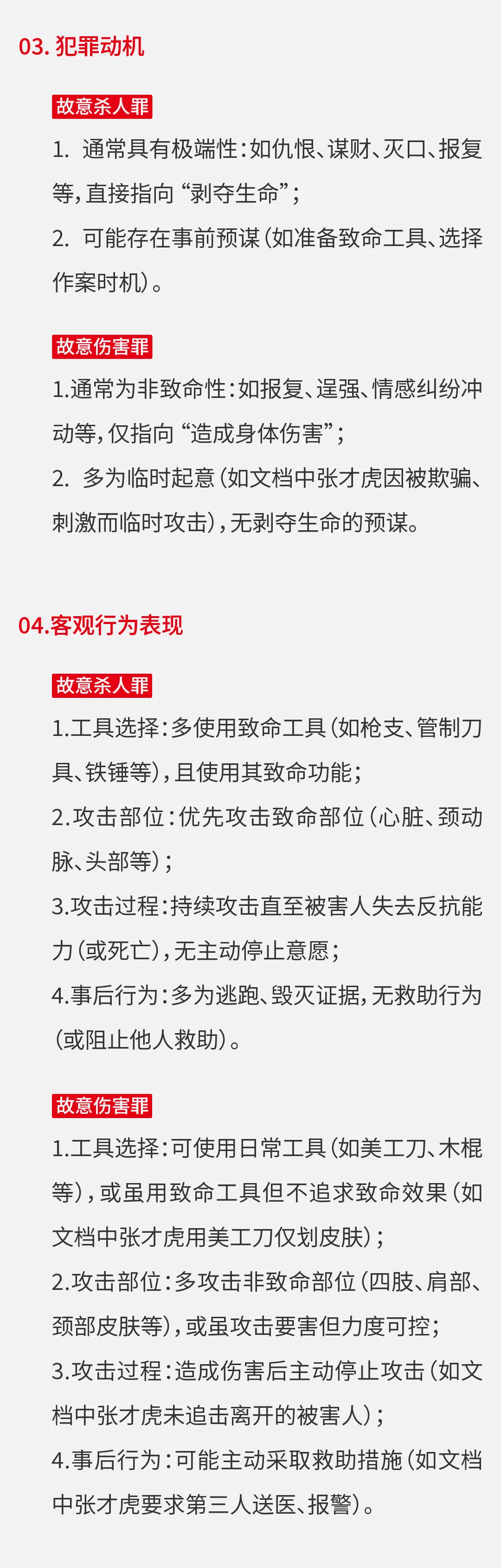
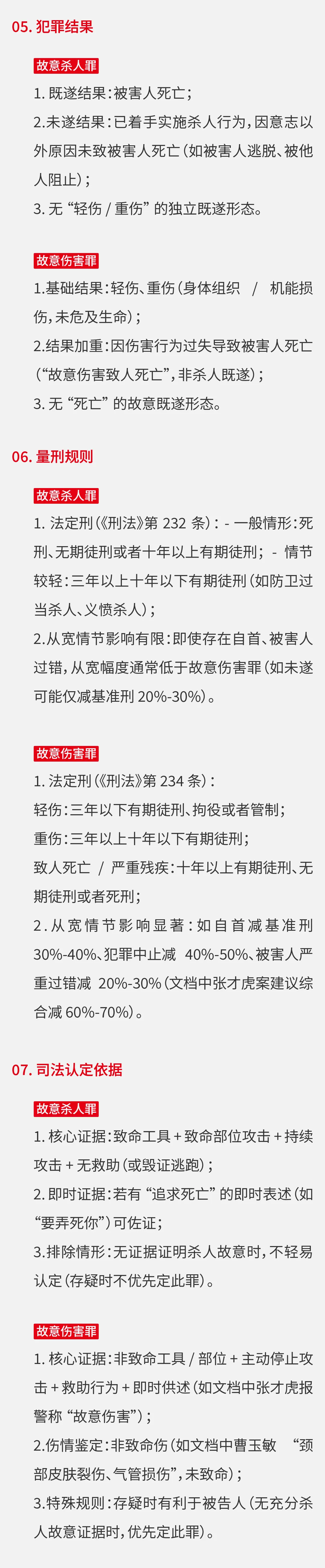
Comparison Table of Key Distinctions Between Intentional Homicide and Intentional Injury
▼
'%20fill='%23FFFFFF'%3E%3Crect%20x='249'%20y='126'%20width='1'%20height='1'%3E%3C/rect%3E%3C/g%3E%3C/g%3E%3C/svg%3E)